



By Joel Phiri
In many households across Mzimba District in the northern part of Malawi, the day often begins with the search for firewood or charcoal to prepare meals. For decades, trees have been the main source of energy for cooking, leading to the steady disappearance of forests across the district. Unlike in the past when they were dense with trees, the district’s forests such as Perekezi and Viphya are now almost bare due to wanton cutting down of trees mainly for charcoal and firewood. However, one young innovator, 26 –year- old -Anthony Botha, is offering a practical solution to the growing problem of deforestation by producing environmentally friendly briquettes made from organic waste and used office paper. He also advocates for the use of Bamboo charcoal.
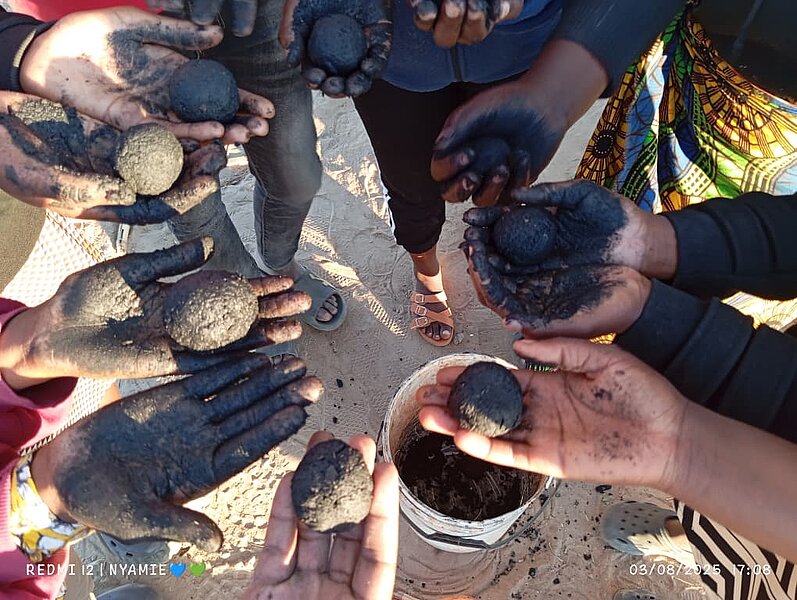
Botha, who hails from Londowala Botha Village, Traditional Authority Kampingo Sibande in Mzimba District, has turned what many consider waste into a valuable source of energy, helping households reduce their dependence on charcoal and firewood. The briquettes are produced using materials such as groundnut shells, coconut shells, tomato wastes, rice husks, cassava peels and discarded office papers. These materials are compressed into solid fuel blocks that can be used for cooking in the same way as charcoal. Botha says the idea was born from his concern about the rapid disappearance of forests in the district.
While growing up around 2008, Mzimba district had dense forests. Many places were covered with trees. But over the years, the forests have been disappearing because people depend heavily on charcoal and firewood for cooking.
According to him, the lack of affordable alternative sources of energy has forced many households to rely on cutting trees.
The reality of our communities is that many people in rural areas depend on charcoal and firewood for cooking energy while a few survives on electricity and gas. The majority are the ones who rely on tree powered energy sources such as charcoal. So, we need to reach out to this group with alternatives energy sources that promote conservation of trees.
In most trading centres and villages in the district, charcoal remains the most common cooking fuel. Large numbers of trees are cut down to produce charcoal, while others are chopped for firewood.
Botha says this situation motivated him to look for sustainable energy alternatives that could help reduce pressure on forests hence settling for briquettes.
Instead of cutting trees, we now produce briquettes using organic waste like groundnut shells and used office papers. These materials are easily available and can be turned into a reliable source of fuel.
The process involves collecting organic waste materials, crushing or shredding them, and then mixing them with water before compressing the mixture into briquettes. Once dried, the briquettes can burn for several hours, providing enough heat for cooking. The initiative is gradually gaining acceptance among local residents, especially women who are responsible for cooking in many households. One of the women who has embraced the use of briquettes is Enart Banda from Kazomba in Mzimba. Banda says she decided to adopt briquettes after noticing that forests around her area were steadily disappearing.
We can clearly see that forests are losing trees every year. If we continue like this, we may not have trees in the future.
She believes communities must take responsibility for protecting forests by embracing alternative energy sources.
We need to reverse that trend. We need to adopt these briquettes.
Banda adds that her experience with briquettes has been positive so far. According to her, the briquettes burn well and provide enough heat to cook meals for her family.
My experience has been good. I am able to cook food using briquettes just like charcoal.
She also notes that the briquettes produce less smoke compared to some types of firewood, making them easier to use in household kitchens.
Ireen Banda, a 36-year-old woman from Chanthomba in Mzimba is also another woman who has adopted use of briquettes.
I grew up here in Mzimba and we used to fetch firewood from Perekezi but I can say the levels of trees are really dimimishing. When I heard about cooking using briquettes I decided to try and I can say they are as good as charcoal. So, I have adopted them, I urge fellow women to try these briquettes.
Beyond producing the briquettes himself, Botha has also started sharing the knowledge with others in the community. He has trained several youth groups in Mzimba on how to produce the briquettes so that more people can adopt the technology. One of the groups he has worked with is Kafoteka Youth Club from Traditional Authority Muzikubola. The training, he says, is meant to empower young people with skills that can help them earn income while contributing to environmental conservation. Youths can start small businesses by producing and selling briquettes in their communities. At the same time, they will be helping to protect our forests.”
Chairperson for Kafoteka Youth Club Mwai Makhala says as a youth Club which also works into conservation they decided to learn the skills of producing briquettes so that they help is protecting trees from the areas they come from. So as a group we have mastered the skill and we produce briquettes for community and some women come to buy from us and many seem to have fallen in love with them. We hope by producing these briquettes we are contributing in our own small way to conservation of forests and trees.
Mzimba District Forestry officer Masozi Shaba admits that the districts face a big challenge in protecting trees and forests.
We admit that indeed we are losing trees and forests faster than we can replace them. As forestry officer we are trying our best to protect forests from invaders but still we feel initiatives by people like Botha are commendable in protecting our forests. Innovation like production of briquettes needs to be encouraged and scaled up in communities for the people to adopt them and through them we can save our forests and trees.
Shaba says production of briquettes can go a long way in environmental sustainability as they will help cut demand on charcoal hence saving trees and forests.
Environmental experts have long warned that deforestation remains one of the major challenges facing many districts in Malawi. Trees are often cut down at a faster rate than they can regenerate, mainly due to demand for charcoal and firewood. This has led to environmental problems such as soil erosion, reduced rainfall patterns and loss of biodiversity. Initiatives such as briquette production are therefore seen as important steps toward reducing reliance on trees as the main energy source.
Botha believes that with the right support, briquette production could significantly reduce deforestation in Mzimba and beyond. He says his long-term vision is to expand the initiative and train more communities across the district.
I would like to partner with various organisations to train communities in briquette making. If more people learn how to produce briquettes, we can reduce the cutting down of trees.
Despite studying Public Administration at Blantyre International University, Botha says his passion has always been environmental conservation. He believes young people have a critical role to play in protecting natural resources for future generations.
For me, conservation is very important. If we do not take action now, future generations may not enjoy the forests that we once had.
Botha’s initiative demonstrates how simple innovations can contribute to solving environmental challenges.By turning waste materials into a source of clean energy, he is not only helping households’ access affordable fuel but also encouraging communities to protect the forests that sustain their livelihoods.
As deforestation continues to threaten natural ecosystems in Mzimba, initiatives like briquette production may offer a practical path toward a greener and more sustainable future.