


By Dr Johann Heilmann
The two DVV International project countries in Southern Africa, Malawi and Mozambique, have much in common. They are at a similar stage of development, are largely rural in character, and in the field of adult education there is a high demand for catch-up basic education, literacy and basic vocational skills. However, they differ in many respects in terms of their adult learning and education (ALE) landscape; each country has its own strengths and weaknesses. In Malawi, the structures of the Community Learning Centres (CLCs), which offer skills training to generate income in rural regions for graduates of state-run literacy courses, as well as integrated adult education programmes, are significantly more developed, whilst Mozambique demonstrates strengths in the content of precisely these integrated programmes. Learning from one another is a natural step.
Peer learning has so far been hampered by a language barrier. The official language in Malawi is English, in Mozambique Portuguese. In the current project phase, which began at the start of the year, DVV International has, however, also commenced work in Mozambique in the neighbouring province of Tete. The advantage here is that Chichewa is spoken in large parts of the province. This is the most widely spoken language in Malawi – so nothing now stands in the way of easy communication.
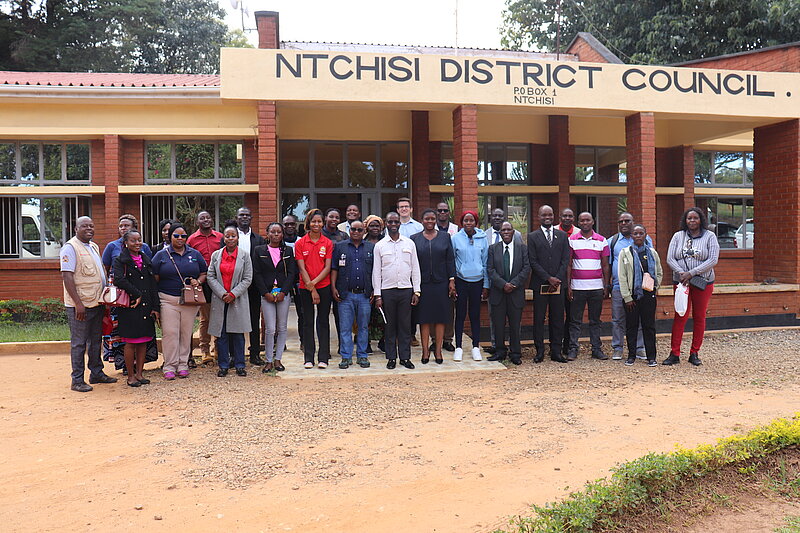
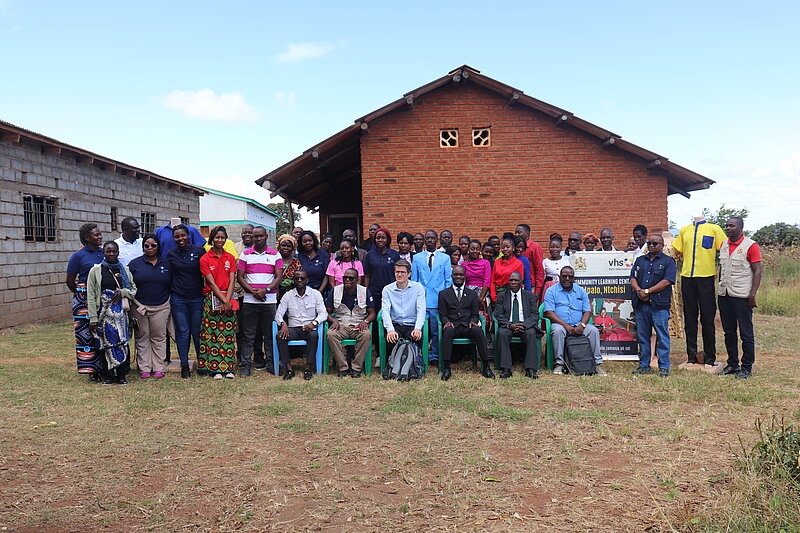
In May 2026, DVV International therefore organised a study tour to Malawi for a Mozambican delegation from Tete Province, accompanied by the director of the DVV International office in the capital, Maputo. The aim of the trip was for the participants to gain a closer understanding of the structures of the CLCs in Malawi, to engage with them, and also to learn how they are integrated into and supported by local communities, and what support is provided by structures at district and national level. The Mozambican delegation consisted of 14 representatives from the district and provincial levels who work in adult education in an administrative or teaching capacity, as well as colleagues from the civil society partner OREMO (Organização Esperança de Moçambique).
In Malawi, DVV International currently supports seven CLCs in the districts of Ntchisi, Dowa, Mchinji and Ntcheu. Two further CLCs are currently being established. Four of these CLCs were visited during the study tour. This gave participants the opportunity to engage in in-depth discussions with the respective CLC management committees, teachers and students, and to inspect the buildings and their surroundings. Particularly inspiring was the visit to CLC graduates, who were able to demonstrate how participating in CLC courses had enabled them to set up a small business, for example in tailoring, and how this now allows them to earn an income.
The Mozambicans were delighted to witness, at a CLC in Mchinji, how a fully qualified female bricklayer was instructing male students. “It is very important that we break down gender stereotypes in Mozambique, too. Every job should be open to every gender,” remarked one participant.
The participants on the study tour were very engaged, asked many questions and were also able to offer valuable suggestions for the day-to-day running of the Malawian CLCs based on their own work experience. The Mozambicans’ visit was rounded off by a reception at the German Embassy in Lilongwe, a meeting with the National Centre for Literacy and Adult Education (NACLAE) and a presentation of DVV International’s project portfolio in Malawi at the regional office.
Armed with their new insights, the Mozambican colleagues can now take further steps towards establishing CLCs in Tete Province. They can be assured of further support from Malawi in this endeavour.